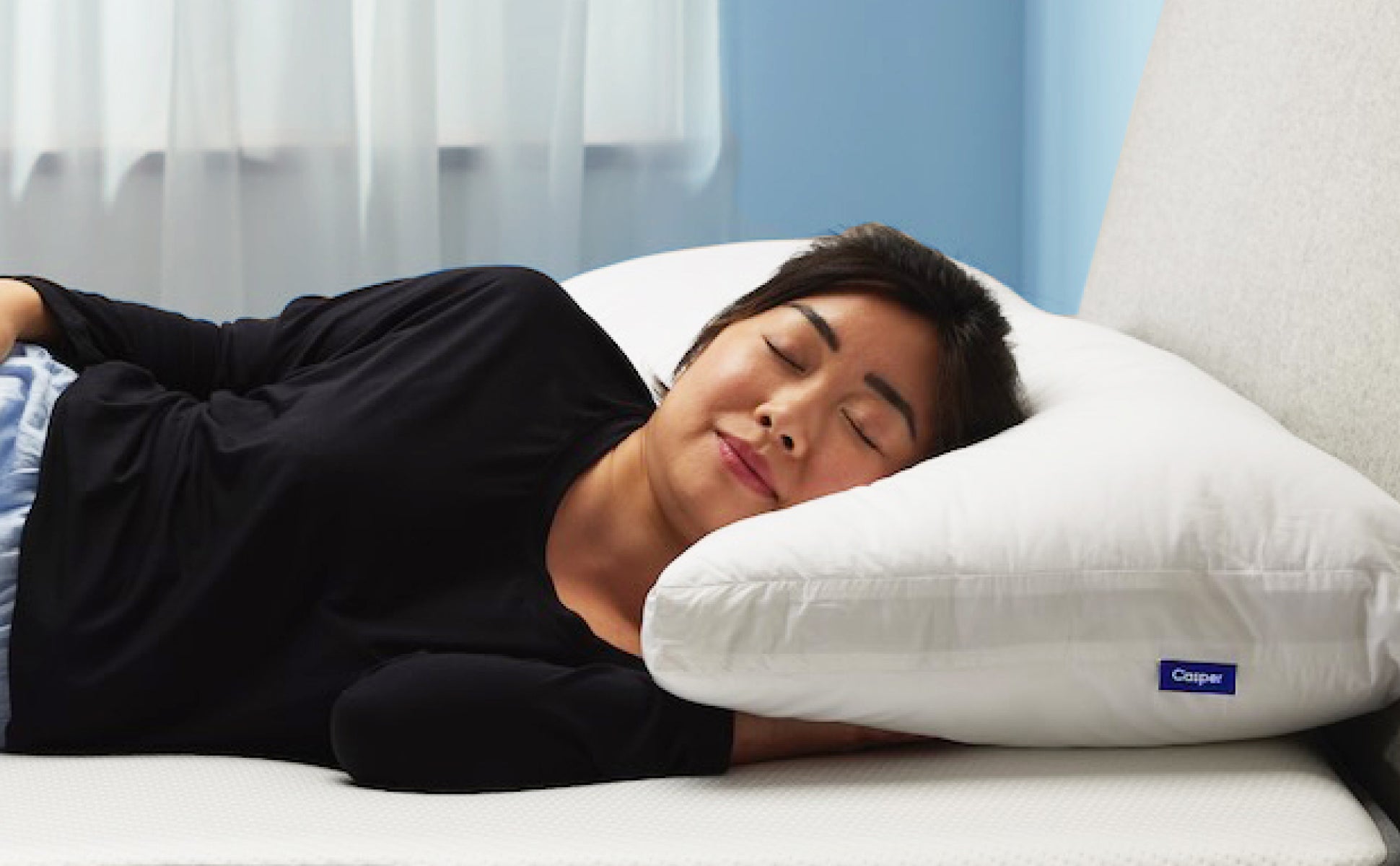
A fiber pillow is filled with polyester microfiber strands instead of memory foam or natural down. The loose fibers move and compress around the head and neck, so the pillow adjusts to different sleep positions rather than holding one fixed shape. Fiber fill feels softer and more responsive than foam, similar to a down pillow, but at a lower price point and with more consistent performance across humidity and temperature. The Original Pillow uses a pillow-in-pillow build: a firmer fiber-filled inner pillow wrapped in a softer fiber-filled outer layer, for contouring support and plush cushioning in one pillow.
The Original Pillow is filled with polyester microfiber — nearly a billion tiny fibers in total. It uses a pillow-in-pillow design: an inner pillow filled with low-friction fibers for contouring support, wrapped in an outer pillow filled with the same fiber for extra cushioning. The cover is 100% cotton in a percale weave for breathability, with a polyester fabric lining underneath. Because it's a down-alternative fill rather than natural down, it gives a similar loft and softness to down without the animal-sourced material, and it's fully machine washable, which most down pillows are not.
Neither is universally better — the right choice depends on feel preference and sleep position. Fiber pillows, like the Original Pillow, use loose polyester fill that's soft, moldable, and machine washable, making them a good all-around choice for back and stomach sleepers who want adjustable loft. Foam pillows hold a consistent shape and offer firmer, more targeted neck support, which tends to suit side sleepers and people with neck pain, but they can't be machine washed (only the cover can). Choose fiber for softness and easy care, or foam for firm, consistent support.
Unzip the outer pillow and remove the inner pillow, then wash both together in the machine. Use cool water with a mild detergent on the gentle cycle, and run the rinse cycle twice to fully clear out detergent residue, which can cause clumping if left behind. Tumble dry on low heat with dryer balls or clean tennis balls to keep the fiber fill from matting as it dries. Wash pillows this way roughly every three to six months, and fluff the pillow by hand daily if possible to help the fiber fill maintain its loft between washes.
All pillows lose some loft with use, but the Original Pillow is built to resist flattening better than a single-layer fill. Because the fiber compresses under weight and then re-expands once pressure is removed, fluffing it daily helps it recover its shape night after night. The two-layer pillow-in-pillow construction also helps, since the inner pillow holds its structure while the outer layer cushions on top.

A memory foam pillow is built from viscoelastic polyurethane foam, a material that slowly compresses under weight and then returns to its original shape once pressure is released. That responsiveness lets it cradle the head and neck rather than pushing back against them the way a firmer foam or fiber fill does. The Foam Pillow uses three layers: softer outer foam for cushioning, an ergonomically curved memory foam center layer that keeps the head and neck aligned, and a removable, machine-washable knit cover. Unlike fiber pillows, foam pillows hold their shape without fluffing, making them a more consistent, low-maintenance option night after night.
The core difference is the fill: memory foam pillows use solid viscoelastic foam that holds a fixed, contoured shape, while fiber pillows use loose polyester fill that compresses and moves with you. That makes foam firmer and more consistent — it doesn't need fluffing and won't clump or flatten unevenly over time — while fiber feels softer and more adjustable, since you can add or remove fill for a different loft. Foam also can't be fully machine washed (only the cover can), while most fiber pillows can go straight into the washing machine. Side sleepers and people who want steady neck support tend to prefer foam; back and stomach sleepers who want a plush, moldable feel often prefer fiber.
A cooling memory foam pillow is a standard memory foam pillow with added materials designed to pull heat away from the head and neck. The Foam Pillow with Snow Technology combines four strategically placed HeatDelete® Bands with phase change material in the outer layers, working together to draw heat off the sleeper and disperse it for roughly 12+ hours of cooler rest. The core structure is otherwise the same three-layer, ergonomically curved memory foam design as the standard Foam Pillow, just with these added cooling layers built around it. This makes it a purpose-built option for people who sleep hot but still want firm, consistent foam support.
Yes, the phase change material and HeatDelete® Bands are specifically designed to pull heat away faster than a standard foam pillow would on its own, so you feel less trapped heat throughout the night. Individual results can vary depending on your sleep environment and body temperature, so pairing a cooling foam pillow with breathable, moisture-wicking sheets tends to make the biggest combined difference.
Yes, foam pillows are generally the best-suited option for side sleepers among the available fill types. The Foam Pillow has a medium-firm feel and a curved center layer designed to fill the gap between the head and shoulder, which helps keep the spine aligned in that position. It's also listed as a strong option for back sleepers, since the same curved layer supports the neck without letting the head tip too far back. Combination sleepers who shift positions through the night tend to do well with it too, thanks to its medium profile. Stomach sleepers, however, are usually better matched with a lower-profile pillow.

A down pillow is filled with down clusters, the soft, fluffy plumage found under a duck's or goose's outer feathers, rather than foam or synthetic fiber. Down clusters trap air between their fine filaments, which is what gives a down pillow its light, cloud-like loft and softness. The Down Pillow uses a 5-chamber design, with separate compartments that keep the fill evenly distributed so it doesn't clump or shift into one corner of the pillow over time. It has a soft feel and a low profile, which makes it a good match for back and stomach sleepers who want a plush pillow that still holds its shape.
Down and feather come from the same bird but are structurally different: down clusters are the soft, quill-less plumage beneath the outer feathers, while feathers have a stiff central quill. Down is lighter, fluffier, and more compressible, which is why higher-down-ratio pillows feel airier and more moldable. Feathers add firmness and structure but can feel flatter and occasionally poke through thin fabric if the quills aren't well contained. Many pillows, including Casper's Down Pillow, actually blend the two: it uses a higher feather ratio in the inner chambers for support and a higher down ratio in the outer chambers for a soft, fluffy feel on contact.
Both. The Down Pillow uses a 5-chamber design with two different fill ratios: the outer chambers are 80% white duck down and 20% feather for a soft, airy feel where your head first makes contact, while the inner chambers are 60% white duck down and 40% feather for firmer, more structured support underneath. This blended approach is common in down-fill pillows generally, since pure, 100% down without any feather content tends to be too soft to hold shape on its own. The outer shell is 100% cotton with polyester inner panels to keep everything contained.
A down alternative pillow uses synthetic fill, usually polyester microfiber, engineered to mimic the loft and softness of natural down without animal-derived material. Casper's Original Pillow is a down alternative, built with a pillow-in-pillow design and polyester fill instead of duck down and feather.
Casper's Down Pillow, by contrast, is real down — not a substitute. It uses a 5-chamber design filled with ethically-sourced white duck down and feather, giving it a lighter, airier feel and better long-term loft recovery. Both pillows are fully machine washable and can be tumble dried on low.
It's possible with poorly constructed pillows, but well-made down and down-feather blends are designed to prevent this. Casper's Down Pillow uses a tightly woven 100% cotton outer shell with polyester inner panels specifically to keep both down and feather quills contained. Feather poke-through is more common in older pillows, cheaper feather-only products, or pillows that have been through many wash cycles without their fabric holding up. If you do notice sharp quills working through the fabric on any feather-filled pillow, that's usually a sign the shell has worn down and the pillow is nearing the end of its useful life.

A hybrid pillow combines more than one type of fill inside a single pillow, rather than relying on just one material the way a foam, fiber, or down pillow does. The Hybrid Pillow uses a three-layer foam-and-fiber design: outer layers of soft foam that hold a consistent shape, wrapped around a down-alternative fiber core that adds a plush, moldable feel, all inside a soft knit cover. The idea is to get the shape-holding consistency of foam and the soft adaptability of fiber in one pillow, rather than having to choose between the two.
The Hybrid Pillow is built in three layers. The outermost layers are soft polyurethane foam, which keep the pillow's shape consistent night after night without flattening or clumping. Inside that sits a down-alternative fiber core made of polyester fiber, which gives the pillow a plush, adaptable feel similar to a fiber pillow. The whole thing is wrapped in a removable, machine-washable knit cover. This layered approach is different from Casper's pillow-in-pillow fiber design in the Original Pillow — here, the foam does the structural work on the outside while the fiber softens the feel underneath it.
A hybrid cooling pillow is a standard hybrid (foam-plus-fiber) pillow with additional materials layered in to pull heat away from the sleeper. The Hybrid Snow Pillow adds a QuickCool™ cover for an immediately cool-to-the-touch feel, Phase Change Material in the outer layers to absorb and disperse heat as it builds up, and HeatDelete® Bands designed to continuously move trapped heat out of the pillow. Combined, this adds up to roughly 12+ hours of cooler rest compared to the standard Hybrid Pillow, while keeping the same foam-and-fiber core construction underneath.
Yes — hybrid pillows are generally positioned as one of the strongest options for side sleepers. The Hybrid Pillow has a medium profile and medium firmness that helps fill the gap between the head and shoulder, which is the main support side sleepers need to keep the spine aligned. It's also listed as a good option for back sleepers and combination sleepers who shift positions overnight, since the foam-and-fiber combination adapts reasonably well across different positions. Stomach sleepers, who generally need a lower, softer profile, are typically better matched with a down or down-alternative pillow instead.
A foam pillow is a solid block of foam layers, giving a firm, consistent feel that holds its shape without any fluffing. A hybrid pillow uses foam only on the outer layers, with a softer fiber core underneath, so it feels plusher and more adaptable than solid foam while still holding its shape better than a pure fiber pillow. In practice, foam pillows tend to run firmer overall, while hybrid pillows sit in between foam and fiber in terms of softness. Both are low-maintenance compared to fiber or down, since neither needs regular fluffing to stay supportive.

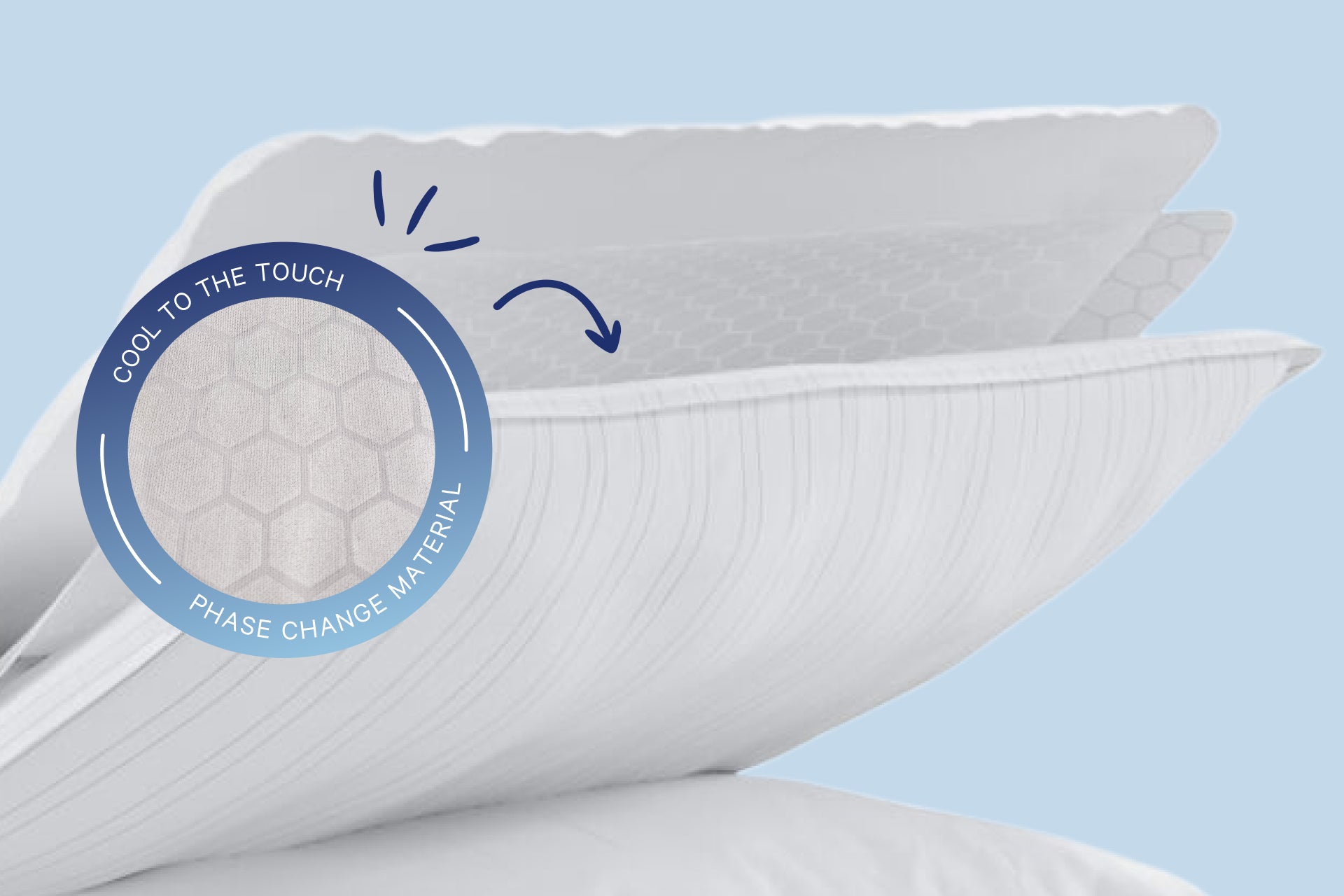
A cooling pillow adds specific materials designed to pull heat away from the head and neck, on top of a standard pillow's fill and construction. The exact approach varies by pillow: the Original Cooling Pillow uses a layer of Phase Change Material (PCM) built into the cover, which absorbs body heat the moment your head touches it. The Foam Pillow with Snow Technology and Hybrid Snow Pillow go further by combining PCM with HeatDelete® Bands that continuously move trapped heat out of the pillow, aiming for roughly 12+ hours of cooler rest. None of these rely on refrigeration, gel packs, or electricity — the cooling comes from the materials themselves.
Phase Change Material (PCM) is a substance that absorbs and releases heat as it changes state, similar to how ice cools a drink as it melts — it's the core cooling ingredient across all of Casper's cooling pillows. Snow Technology is the broader system built around that: it combines PCM with HeatDelete® Bands (which actively move heat out of the pillow over the course of the night) and, on some models, a QuickCool™ cover for an instant cool-to-the-touch feel on contact. In short, PCM alone gives you a cool surface on contact, while Snow Technology adds ongoing heat transfer designed to keep working for hours, not just at first touch.
Yes! The phase change material and, on select models, HeatDelete® Bands are engineered to pull heat away from the head and neck rather than let it build up the way a standard pillow does. Because the technology draws heat away rather than actively refrigerating the pillow, it tends to make the biggest difference for people who run genuinely warm at night — pairing it with breathable sheets and a cooler bedroom temperature helps maximize the effect.
Casper's cooling lineup covers three different constructions. The Original Cooling Pillow is a down-alternative fiber pillow with a pillow-in-pillow design, PCM built into the cover, and a soft TENCEL™ lyocell and cotton blend outer layer — closest in feel to a standard fiber pillow. The Foam Pillow with Snow Technology is a firmer, three-layer memory foam pillow with PCM and HeatDelete® Bands added. The Hybrid Snow Pillow combines foam and down-alternative fiber with PCM, HeatDelete® Bands, and a QuickCool™ cover. Each is aimed at a different feel — soft and adaptable, firm and structured, or a balance of the two — with cooling layered on top.
It depends on the feel you already prefer, since all three of Casper's cooling pillows use some version of PCM. If you like a soft, fiber-style pillow and run warm at night, the Original Cooling Pillow adds PCM to that familiar feel at the lowest price point of the three. If you want firm, consistent neck support along with cooling, the Foam Pillow with Snow Technology adds HeatDelete® Bands on top of memory foam for more active heat transfer. If you want a middle-ground feel — foam structure with a softer fiber core — the Hybrid Snow Pillow includes the most complete cooling package (PCM, HeatDelete® Bands, and a cool-touch cover), but also costs the most.


Pillow Size Guide
Choose standard if you're outfitting a twin, twin XL, full, or queen bed, or if you simply prefer a more traditional pillow size — it's the size most pillowcases are designed for, and it works well for most sleepers regardless of body size. Choose king if you have a king or California king bed and want the pillows to visually balance the wider mattress, or if you tend to move around a lot at night and want more surface area to work with. King pillows run about 30% larger than standard and cost more across every Casper pillow model, so the choice comes down to bed size and personal preference rather than one being objectively better.

Standard Size Pillows
A standard size pillow is the most common pillow size sold in the U.S., generally measuring around 20" x 26", though the exact width can vary a bit by brand and fill type. It's designed to work on twin, twin XL, full, and queen beds, and is also sometimes labeled "queen size" by other brands, since the two terms usually refer to the same dimensions. Across Casper's pillow lineup, Standard is the base size offered on every model, with King as the larger upgrade option for those who want more surface area or are dressing a wider bed.
It depends on which pillow, since Casper's Standard size isn't identical across every fill type. The Original Pillow, Down Pillow, and Original Cooling Pillow all measure 18" x 26" in Standard. The Hybrid Pillow measures 15.6" x 24", and the Foam Pillow and Foam Pillow with Snow Technology measure roughly 16" x 24". The height (uncompressed loft) also varies by construction — fiber and down pillows sit around 8"–9" uncompressed, while foam and hybrid pillows sit lower, around 5.5"–6". If you're comparing dimensions across pillow types, it's worth checking the specific product's spec table rather than assuming "Standard" means the same footprint everywhere.
Yes — "standard" and "queen" are generally two names for the same pillow size, both measuring around 20" x 26" in the pillow industry overall. The naming difference mostly comes down to brand convention: some companies label their base pillow size "Standard," others call it "Queen," and a few list both terms together. Either way, it's the size intended to fit twin, twin XL, full, and queen beds, and it's the default size most pillowcases and shams are cut for.
Standard pillows work on twin, twin XL, full, and queen beds — essentially any mattress up to queen width. They're the default, best-selling size across nearly every pillow brand, including Casper's own lineup, because they suit the widest range of bed sizes without looking oversized or undersized. King and California king beds can technically use standard pillows too, but they tend to look proportionally small against that much mattress width, which is why king-size pillows exist as the wider alternative for those bed sizes.
Two standard pillows side by side is the classic setup for a full or queen bed — it's also the size most pillowcases and shams are designed around, so it's the easiest arrangement to accessorize. On a twin or twin XL bed, one pillow is usually enough, since the narrower mattress makes two feel crowded. If you want extra pillows up front for reading or lounging, treat those as a separate decorative layer rather than doubling up on your main sleeping pillows.

King Size Pillows
A king size pillow is the larger of the two standard pillow sizes, measuring roughly 30% wider than a Standard/Queen pillow. It's designed for king beds and California king beds, where a pair of standard pillows would leave visible gaps on either side of the mattress. Across Casper's lineup, King is offered as the upgrade size on every pillow model, typically adding somewhere between $18 and $37 to the price depending on the fill type and construction.
It depends on the fill type, since King isn't one fixed footprint across every pillow. Casper's fiber-based pillows (Original Pillow, Original Cooling Pillow) and its Down Pillow all measure 18" x 34" in King. The Hybrid Pillow measures narrower, at 15.6" x 31". Height also varies: fiber and down pillows sit around 8"–9" uncompressed, while foam and hybrid pillows run lower, generally in the 5.5"–6" range. If exact width matters for your bed setup, check the specific pillow's product page rather than assuming all "King" pillows share the same measurements.
Either technically works on a king bed, but king pillows are the better proportional match. Two king pillows side by side come closer to filling a king mattress's width, while two standard pillows leave visible mattress space on either side. If you prefer that more minimal, gapped look, or you're on a tighter budget, standard pillows are a perfectly functional choice on a king bed — it's a styling preference rather than a compatibility issue. If you want the pillows to visually anchor the width of the bed, king is the closer fit.
Either technically works on a king bed, but king pillows are the better proportional match. Two king pillows side by side come closer to filling a king mattress's width, while two standard pillows leave visible mattress space on either side. If you prefer that more minimal, gapped look, or you're on a tighter budget, standard pillows are a perfectly functional choice on a king bed — it's a styling preference rather than a compatibility issue. If you want the pillows to visually anchor the width of the bed, king is the closer fit.
A king size down pillow is Casper's Down Pillow in its larger size option, measuring 18" x 34" versus 18" x 26" for the standard size — about 30% more width, with the same 8" uncompressed loft and 2" gusset either way. The fill and construction are identical to the standard version: a 5-chamber design with an 80/20 down-to-feather ratio in the outer chambers and a 60/40 ratio in the inner chambers, wrapped in a 100% cotton outer shell. The only real difference between the standard and king down pillow is the footprint — the softness, support, and feel are the same.
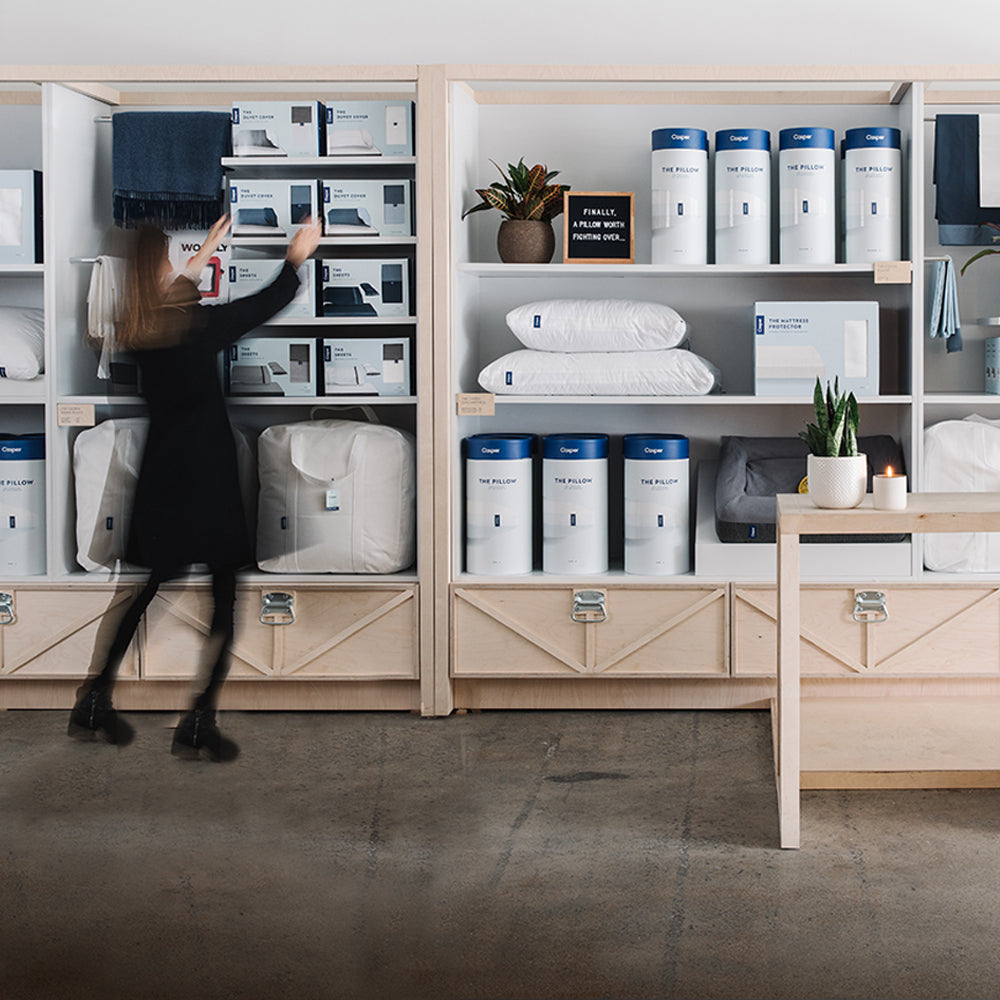
Feel the difference in person. Try products for yourself and chat with a Sleep Specialist at a store near you.

Our Sleep Specialists are dedicated to helping you find the mattress of your dreams. Give us a call or chat with us now.

Our Comparable Value prices reflect the price at which we or third parties have offered this item or a comparable item.
 How does Casper create the best value products for their sleepers?
Our team regularly searches the market and tests comparable mattress and sleep products to ensure that ours offer top-quality materials, the most value for your dollar, and the best sleep experience on the market.
 Every Casper mattress is designed and assembled in the USA.
As part of the Carpenter Co family, Casper mattresses are manufactured by the largest foam manufacturer in the world—no middle man, no markups, just the best prices for our sleepers.
 We don’t rely on gimmicks—just 12+ years of expertise.
With 12+ years in the mattress and bedding industry, the Casper team knows what makes a great night’s rest and what’s just fluff. Our mattresses and bedding are obsessively-engineered and precisely-layered to help you get your deepest sleep ever.
 We don’t sleep on getting you the best possible deal.
The Comp. Value shown for Casper products is never set it and forget it. Our team conducts thorough market research every quarter to ensure our comparable value is always accurate to the bedding market and the three most comparable products, so you never have to worry about missing out on savings.